Aperture
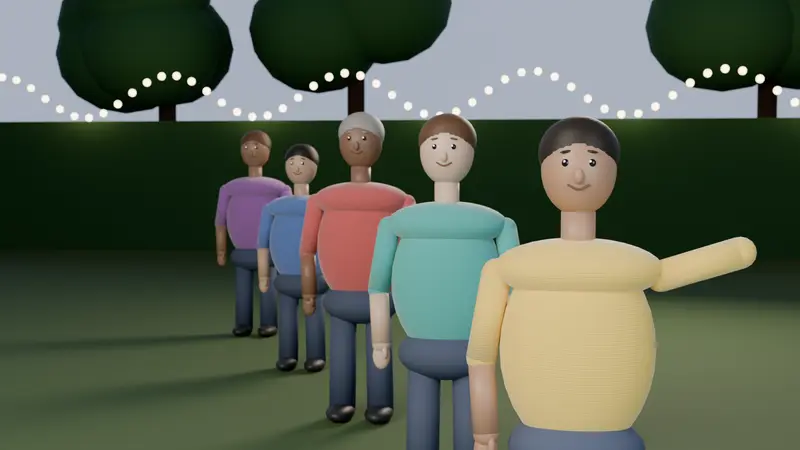
Turn the dial and watch two things change: how bright the photo is, and how blurry the background gets.
ExposureBalanced
What’s sharp, seen from above
Medium depth of fieldSharp from 2.6 m to 6.0 m: 2 of 5 people in focus. The camera is focused at 3.6 m with a 50 mm lens.
Aperture isn’t the only thing that blurs a background: a longer lens, standing closer, or a background further away all blur it more.
0 stopsf/5.6
← less light · sharper backgroundmore light · softer →
Inside the lens
The hole is 8.9 mm across on this 50 mm lens: 50 ÷ 8.9 = 5.6. f/5.6: the starting point.
Light inf/1.4 = full bar
Keep the exposure balancedOff: the other settings stay put, so brightness changes as you turn.
Shutter speed
1/125
fixed
ISO
ISO 400
fixed
Challenges
- 1.Let in 2 stops more light than f/5.6.
- 2.Blur the people at the back as much as you can, with the meter on 0.
- 3.Get all five people sharp, front to back.
How aperture works
Aperture is the hole in the lens that light comes through. It’s written as an f-number, and it feels backwards: a small number like f/1.4 is a big hole, and a big number like f/16 is a small one.
- Why a bigger hole is a smaller number
- The f-number is the lens length divided by the width of the hole. On a 50 mm lens, f/2 is a 25 mm hole and f/16 is about 3 mm. Halve the number and the hole is twice as wide, which lets in four times the light: two stops.
- The light
- Every step on the dial doubles or halves the light. f/5.6 to f/4 is twice the light; f/5.6 to f/8 is half.
- The look
- Aperture sets how much of the scene, front to back, is sharp: the depth of field. Wide (f/2) keeps only your subject sharp, which suits portraits. Narrow (f/11 to f/16) keeps near and far sharp, which you need for groups and landscapes.
- On a real camera
- The "keep the exposure balanced" switch works like Aperture priority (A or Av): you pick the aperture, the camera picks the shutter speed.
Every stop at a glance
50 mm lens, focused at 3.6 m.
| Aperture | Hole | Light vs f/5.6 | Sharp from–to |
|---|---|---|---|
| f/16 | 3.1 mm | ⅛ | 1.7 m – ∞ |
| f/11 | 4.5 mm | ¼ | 2.0 m – 16.4 m |
| f/8 | 6.3 mm | ½ | 2.3 m – 8.3 m |
| f/5.6 | 8.9 mm | 1× | 2.6 m – 6.0 m |
| f/4 | 12.5 mm | 2× | 2.8 m – 5.0 m |
| f/2.8 | 17.9 mm | 4× | 3.0 m – 4.5 m |
| f/2 | 25 mm | 8× | 3.2 m – 4.2 m |
| f/1.4 | 35.7 mm | 16× | 3.3 m – 4.0 m |